|

Scientists plan to save whales by collecting their snot
 Dinah Voyles Pulver
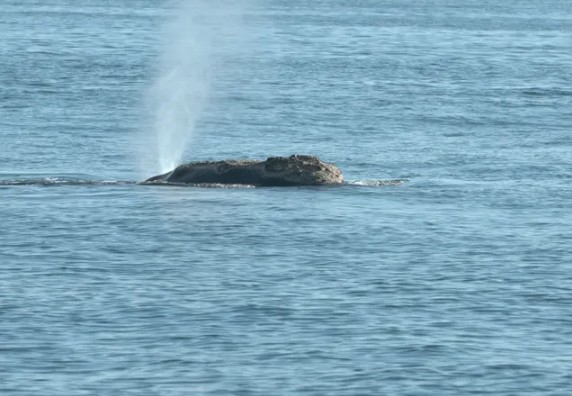
You can call it spit, snot or respiratory drops, but a research team has found the moisture that emerges in the unique v-shaped “blow” of endangered North Atlantic right whales holds important clues about their health.
Researchers have collaborated for decades on ways to improve the care, treatment and management of the critically endangered species. But treating the animals when they are ill is a difficult proposition.
The whales weigh in at 70 tons and are longer than a school bus, so taking them to the local vet is out of the question. And when a vet goes to the whale, either to try to remove entangled fishing gear, administer antibiotics or take a biopsy or blood sample, it’s dangerous to be so close to such massive animal in the open ocean.
It’s also “really stressful and impactful for the animals” when people try to get that close, said Carolyn Miller, a research associate at Woods Hole Oceanographic Institution who has studied right whales for decades. That makes treating them for injuries “a huge challenge.”
In 2016, Miller and others began flying a drone with a petri dish through the spray that a whale exhales when it surfaces. By 2024, they had captured more than 100 samples from 85 individual whales in Cape Cod Bay.
With that information, they found a link between the different types of bacteria and how robust or how skinny the whales are, said Miller, lead author of the study collaborating with the University of St Andrews, New England Aquarium, SR³, and Whale and Dolphin Conservation. Their work was recently published in the ISME (International Society for Microbial Ecology) Journal.

“It’s really exciting that we’re seeing that the microbes and the breath of these animals appears to be linked to their body condition, because we might have another way to do a health check-up,” Miller said.
When a whale exhales
If you’ve ever put your face up to an icy cold window or mirror and breathed out a cloud of moisture that fogged the glass, that’s the same principle the scientists are using to capture microbes in the moisture exhaled by the whales.
It might be compared to some of the newer human diagnostics such as swabbing nostrils during the Covid 19 pandemic or spitting into a tube to find your long-lost ancestors. The difference is the v-shaped blow of a right whale emerges with much more energy and moisture than human breath.
“They exhale very powerfully, much more so than we do,” Miller said. “So you can imagine, there’s a lot of droplets that come out when they blow.”

A drone pilot can be hundreds of feet away on a boat, so collecting the drops is not invasive to the animal and doesn’t appear to disrupt its behavior, Miller said.
“We try to stay as far away as we possibly can,” she said. They want to maintain a line of sight with the drone but be far enough away not to disturb the whale.
That work is “highly regulated” under permits with the federal agencies who oversee whale protection and set the laws that prohibit flying drones over whales, said Suzanne Pelisson, director of public relations at Woods Hole.
The remaining population is estimated at 384 whales, plus or minus 9 or 10 animals, according to the most recent figures from the North Atlantic Right Whale Consortium.
Scientists began exploring using drones to collect information about whales, including their blows, in the early 2000s. Woods Hole scientists, including Michael Moore, began talking with researchers experimenting with drones to study penguins and whales in Antarctica and New Zealand. Iian Kerr, CEO at the nonprofit Ocean Alliance, is credited with pioneering a “SnotBot” drone, in collaboration with the Olin College of Engineering.

How the discovery might help
“This is the first time a connection between the respiratory microbes – or the bacteria in the breath of whales – has been tied to the health of a free-swimming whale population,” Miller said.
There’s more research to be done to fully explore what the findings could mean. But having multiple and meaningful ways of monitoring the health of these animals is extremely important, she said. That’s “a critical step toward coming up with ways and policies to protect them.”
“The population is so small, we need to reduce the number of deaths, especially from ship strikes and fishing gear entanglements. That’s where a lot of the management is focused, but we also really need to find ways to increase their health and reproductive health and success.”

Sufficient body fat is critical for a female whale’s calving success, Miller and others found in previous studies. Fat reserves are essential for female whales to migrate to the calving grounds, from New England and Nova Scotia to the waters off the coast of Florida and Georgia. The work of Miller and others has shown that underweight females may be one of the things preventing right whales from producing more calves.
That migration – which includes pregnant females, young whales and occasional others – is already under way for the 2025-2026 season. Right whales have been spotted off the Carolinas.

The pregnant females also have to expend extra energy if they suffer a severe injury from a gear entanglement or ship collision, so a female “has to be in really good condition,” Miller said.
The latest findings are particularly rewarding, Miller said, because they add to decades of work by many scientists and organizations who have built long-term databases and photo identification catalogues to study the whales. Samples of the microbes collected were paired with that previous work, including a long-term health and survival model.
A group of scientists studying whale genetics is looking at additional samples from the petri dishes to see if they could help map a whale’s family tree like the work being done in humans by companies such as Ancestry.com.
“They don’t quite know if there’s going to be enough DNA,” she said. Scientists can get DNA samples from the whales by approaching and firing an arrow from a crossbow that takes a little biopsy, but they’re hoping to be able to use the moisture in the petri dishes to look at genetic information.
Saving endangered right whales

Dinah Voyles Pulver covers climate change, wildlife and the environment for USA TODAY. Reach her at dpulver@usatoday.com or @dinahvp on Bluesky or X or dinahvp.77 on Signal.