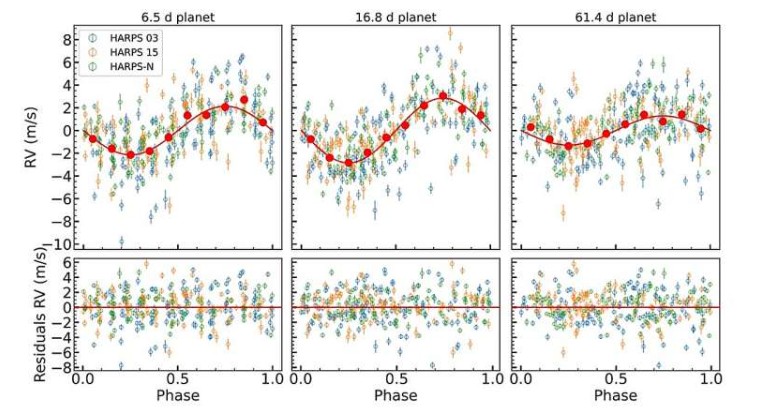
Astronomers using the HARPS and HARPS-N spectrographs have discovered a third exoplanet in the planetary system HD 176986, located 91 light-years from Earth, according to a study in Astronomy and Astrophysics. The new planet, HD 176986 d, orbits the star every 61.38 days and has a minimum mass of 6.76 times that of Earth.
|
Third exoplanet detected in the planetary system HD 176986
Using HARPS and HARPS-N spectrographs, astronomers have observed a nearby K-type star designated HD 176986, known to host two super-Earth exoplanets. The observations resulted in the discovery of another planet in the system at least several times more massive than Earth. The finding was detailed in a paper published January 28 in the Astronomy & Astrophysics journal.
Super-Earth system
Located some 91 light years away from Earth, HD 176986 is a star of spectral type K2.5V, about 21% smaller and less massive than the sun. The star is estimated to be 4.3 billion years old, has an effective temperature of 4,931 K, and metallicity at a level of 0.03 dex.
In 2018, two exoplanets orbiting HD 176986 were discovered: HD 176986 b and HD 176986 c, orbiting the host star every 6.5 and 16.82 days, respectively. HD 176986 b has a minimum mass of 5.74 Earth masses, while the mass of HD 176986 c was calculated to be at least 9.18 Earth masses.
A team of astronomers led by Nicola Nari of the Teide Observatory, Spain, has re-investigated the planetary system HD 176986, using the High Accuracy Radial velocity Planet Searcher (HARPS) mounted on the ESO 3.6 m Telescope at La Silla Observatory in Chile, and its counterpart for the Northern Hemisphere—HARPS-N, installed on the Galileo National Telescope at the Roque de los Muchachos Observatory in Spain. The observations were conducted as part of the Rocky Planets in Equatorial Stars (RoPES) program.
“We revisited the planetary system of HD 176986, a K2.5 star intensively observed with HARPS and HARPS-N, which is known for hosting two super-Earths in a close orbit. We considered a larger dataset compared to the original work, growing from 234 to 330 nights of observations and with a longer baseline, from 13.2 years to 18.6 years,” the researchers wrote in the paper.
Outer companion
The observations detected a planet orbiting HD 176986 every 61.38 days, at a distance of some 0.28 AU from it. The newfound alien world received designation HD 176986 d, and its equilibrium temperature was found to be 363 K. The minimum mass of HD 176986 d is estimated to be 6.76 Earth masses.
According to the astronomers, the discovery of HD 176986 d underscores the capabilities of blind search radial velocity surveys as RoPES, to detect super-Earth or sub-Neptune exoplanets with orbital periods of more than 50 days. Moreover, this detection proves that long-term radial velocity surveys are essential to better explore the habitable zones of K- or G-type stars.
The observations performed by Nari’s team have also refined the parameters of the previously known planets orbiting HD 176986. It turned out that HD 176986 b has an orbital period of 6.49 days, a minimum mass of 5.36 Earth masses, and an equilibrium temperature of 767 K.
When it comes to HD 176986 c, it encircles the star every 16.81 days, has an equilibrium temperature of 558 K, and is estimated to have a mass of at least 9.75 Earth masses.
Written for you by our author Tomasz Nowakowski, edited by Sadie Harley, and fact-checked and reviewed by Robert Egan—this article is the result of careful human work. We rely on readers like you to keep independent science journalism alive. If this reporting matters to you, please consider a donation (especially monthly). You’ll get an ad-free account as a thank-you.