
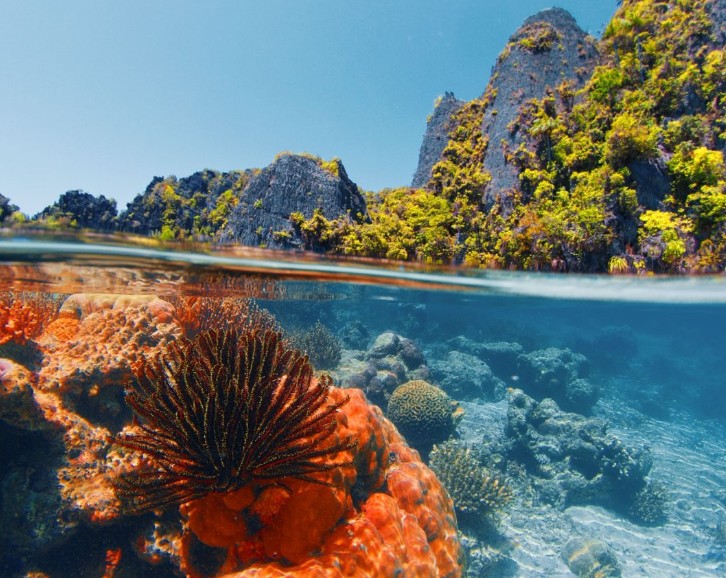
| Assisted evolution for corals needs faster development |
 |
| (Eloi_Omella/Getty Images) |
| Full Story: Earth (3/31) |

Scientists race to help corals evolve before oceans get too hot



 Follow Earth on Google
Coral reefs are running out of time. Ocean heat waves are becoming more frequent and more intense, and each one pushes reefs closer to collapse.
Against that backdrop, a growing number of scientists are exploring “assisted evolution” – a set of approaches designed to help corals adapt faster than nature can manage on its own.

A new paper argues that this research has real promise, but it’s not moving nearly fast enough.
Without a major acceleration – and without rapid cuts in greenhouse gas emissions – the authors warn that assisted evolution tools could mature only after many reefs have already been lost.
How assisted evolution works
The basic idea is straightforward: corals can adapt, but the climate is changing faster than their natural pace of evolution.
Assisted evolution aims to speed up coral adaptation so reefs can better tolerate higher temperatures and survive marine heat waves with less mass mortality.
Over the past few decades, researchers have made real progress in understanding what makes some corals more heat-tolerant than others.
But the new paper says the gap between knowledge and usable, scalable solutions is still too large – and the ocean is warming too quickly.
“Assisted evolution methods look promising. But at today’s pace of research and development, and without rapid emissions reduction, solutions will arrive too late for coral reefs,” said study co-author Dr. Adriana Humanes, a research associate at Newcastle University.
Coral heat tolerance remains unclear
Progress is slow because scientists still have major unanswered questions about the biology of coral heat tolerance. What exactly makes some corals resist bleaching, recover faster, or survive heat waves better?
“Critical knowledge gaps around the biology of coral heat tolerance are hindering progress,” said study co-author Dr. Juan Ortiz, a research scientist from the Australian Institute of Marine Science (AIMS).
The paper lays out a research agenda with nine priorities meant to close those gaps and speed up the development of assisted evolution methods.
But the authors also say that even a perfect agenda won’t matter unless the field changes how it works, because the time window is short.
Bigger field hubs for reefs
The team highlights three big changes they think are necessary to give assisted evolution a realistic chance of helping reefs at scale. The first is much bigger, field-based coral research.
The authors argue that coral science can’t rely on small, scattered experiments if it wants fast answers.
They want large-scale field “hubs” where multiple experiments can run in parallel, across multiple coral species and life stages, with shared infrastructure and teams.
“We need to scale up field-based coral reef science so we can answer many of these questions simultaneously and in record time,” said co-author James Guest from Newcastle University.
This is basically the coral equivalent of moving from boutique lab work to something more like a coordinated research network – where bigger datasets and faster iteration become possible.
Funding coral research long-term
Second, the authors point out that funding should match coral biology, not grant cycles. Corals don’t operate on three-year timelines, but research funding often does.
That mismatch creates a real bottleneck, especially if the goal is to understand whether assisted evolution benefits persist across generations.
“Corals have a complex life cycle,” Dr. Ortiz said. “It takes three to seven years for baby corals to mature and reproduce, yet most funding schemes run for only three years.”
The paper argues that multi-generational studies aren’t a luxury – they’re essential. If assisted evolution produces corals that survive one heat wave but fail later, or produce weaker offspring, that’s the kind of problem you only catch with longer-term work.
Protecting coral research from loss
Researchers must protect the hubs and experimental corals from being wiped out. This risk is easy to overlook until you imagine the worst case.
Teams spend years building broodstock, running experiments, and tracking traits. Then a major storm or heat wave kills the corals and destroys the entire dataset in progress.
“Both experimental corals and broodstock housed in these hubs hold knowledge that will only be revealed over time,” Dr. Humanes said. “If they are lost during disturbances, the financial investment loss could be huge and delays could be catastrophic.”
The paper argues that researchers should place hubs strategically and use local protective measures when extreme events hit.
Examples include temporarily lowering corals into deeper water during storms or using interventions like cloud brightening or fogging during marine heat waves to reduce heat stress.
No single solution for saving reefs
The paper also makes it clear that scientists shouldn’t treat assisted evolution as a one-size-fits-all “hero solution.” It’s one tool that needs to sit inside a broader portfolio of actions to safeguard reefs.
“Indeed, supporting multi-generational research and scaling up proven, field-based solutions are central to the mission of the G20 Coral Research and Development Accelerator Platform (CORDAP),” said Carla Lourenço from CORDAP.
“Because there is no single solution to safeguarding coral reefs, a portfolio of complementary strategies in which coral assisted evolution is a central part is needed.”
In other words: reefs will likely need multiple overlapping strategies – restoration, conservation, local stress reduction, better monitoring, and assisted evolution – working together.
Emissions cuts still come first
Even with better science and faster scaling, the authors don’t sugarcoat the biggest reality. Assisted evolution can potentially buy time and reduce losses, but it can’t “out-evolve” unlimited warming.
If emissions keep rising, the heat stress will eventually overwhelm even the best-adapted corals.
So while the paper is a call to accelerate innovation, it’s also a warning that innovation can’t substitute for cutting greenhouse gas emissions.
The message is simple. We should push assisted evolution forward hard. But we also need to stop turning the ocean into a hotter and hotter test chamber, or we’ll run out of reefs before the tools are ready.
The full study is published in the journal Nature Reviews Biodiversity.
—–
Like what you read? Subscribe to our newsletter for engaging articles, exclusive content, and the latest updates.
Check us out on EarthSnap, a free app brought to you by Eric Ralls and Earth.com.
—–


Leave A Comment