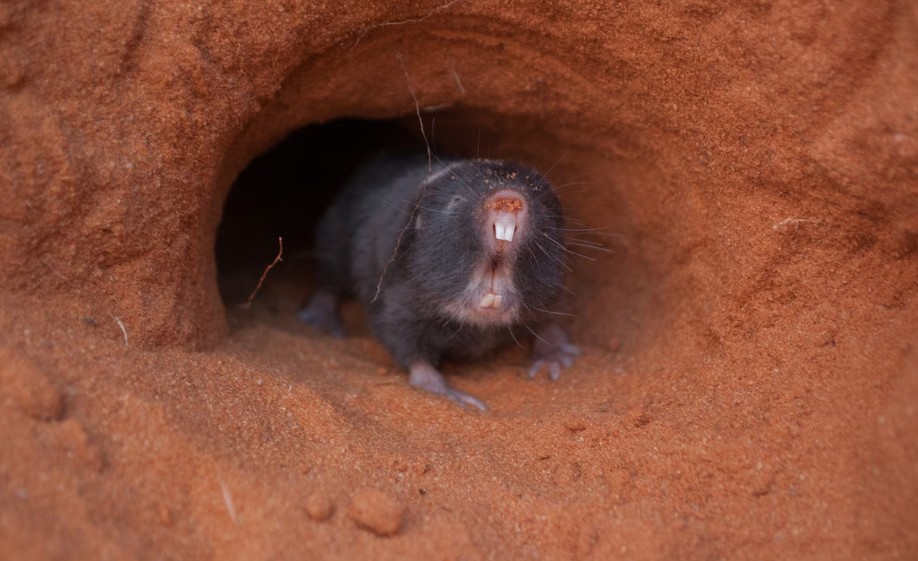
Watch a mole-rat ‘farmer’ at work in its elaborate subterranean city
The reclusive subterranean rodents, often studied for their cancer-fighting biology, backfill their tunnels to regenerate partially eaten plants—a practice that may predate human farming.
For millennia, humans were believed to be the only mammals to farm, defined as the practice of cultivating soil and producing crops or other foods. That all changed in 2022, when a peer-reviewed study revealed that southeastern pocket gophers not only excavate vast subterranean tunnel systems, which accelerates regrowth of partially eaten roots, but also use their excrement to further fertilize the soil. “If farming is the management of crops, that’s what they’re doing,” Francis Putz, the University of Florida biologist who led the study, told National Geographic at the time. Far from being irksome invaders, his co-author argued, gophers are invaluable “agricultural partners” who engineer and enrich ecosystems.
Now, a new cohort of field researchers says the evidence of farming behavior may be even stronger among another group of mammals: mole-rats, a family of subterranean rodents found only on, or rather, in, African soil.
Mole-rats are already renowned for their remarkable cancer-fighting, anti-aging biology, which researchers hope can unlock new insights on how to extend human longevity. The biology of naked mole-rats—smaller and more distantly related evolutionary cousins of the mole-rats in southern Africa—have attracted particular curiosity. But mole-rats’ behavior underground has gotten far less attention.
According to Kyle Finn, a zoologist at the Kalahari Research Center and postdoctoral fellow at Linnaeus University, evidence of mole-rats farming geophytes—i.e. plants that store nutrients underground in bulbs and tubers—has been documented in at least a half-dozen academic papers, though often as a footnote rather than a primary research focus. “Sometimes scientists get tunnel vision when it comes to mole-rats and the fountain of youth,” Finn says, “but the vast subterranean worlds these animals construct are remarkable in their own right.” In some cases, mole-rats have even been shown to construct tunnels that spiral 360 degrees around a nutrient-rich tuber to savor it from all sides.
The studies find that instead of merely aerating and fertilizing soil like pocket gophers, mole-rats energetically backfill their tunnels with dirt to accelerate plant regeneration. The tubers and bulbs of wild ginger, fleshy cucumbers, and sweet potatoes are among their favorites.
“Many parts of sub-Saharan Africa look vacant at first glance,” Finn says, “because all the action is happening below the surface.”
Unconventional agriculture in a lightless world
African mole-rats have lived less than a foot below humanity’s feet since the dawn of our species—but only in the past two decades have scientists begun to make sense of what’s happening inside their subterranean worlds.
Zoologists got their first full glimpse into the rodents’ sophisticated underground strongholds in 2009, when Czech researcher Radim Šumbera and his team used radio-tracking to monitor mole-rat movements and then spent more than a month excavating the areas the animals roamed. The scale of the self-sufficient compound they uncovered was staggering.
Nearly two miles of tunnels weaved between family nests, food-storage chambers filled with harvested plants, and designated toilet areas. The majority of the tunnels were just inches belowground, but some deeper ones—colloquially called “highways”—facilitated efficient transit between key locations. Given the limited number of places wide enough to turn around, mole-rats have also mastered the art of running backward, shuttling around like subway cars.
(Using open-access data and Šumbera’s raw field notes, cartographer Oliver Uberti created a first of its kind map of these underground communities. See it here, or it’s published in my new book, The Hidden Nations of Animals.)