|


How starfish coordinate hundreds of tube feet without a brain



 Follow Earth on Google
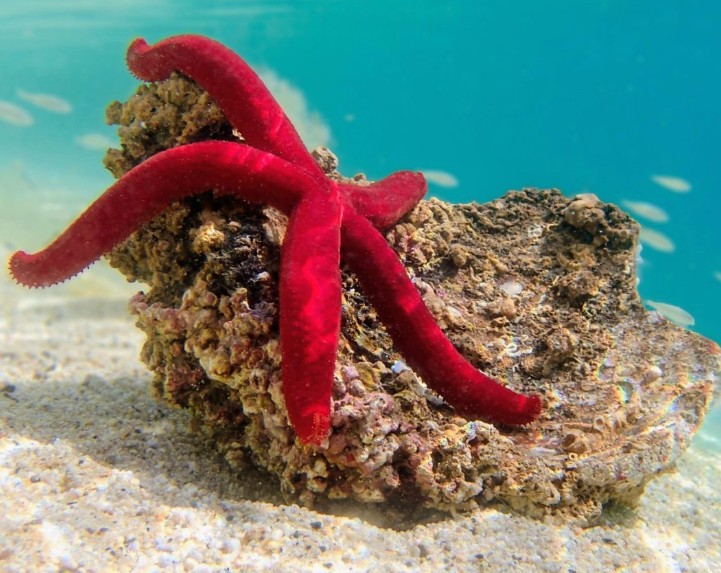
Starfish, also known as sea stars, appear simple at first glance. They have no head, no brain, no blood, and no central nervous system. Yet they move steadily across rocks, glass, and sand with surprising control.
This movement has puzzled scientists for years. How does an animal move so well without a command center inside the body?

A new study explores this mystery. The research shows that starfish do not rely on a central control system. Instead, movement comes from small local actions working together.
Each tiny foot reacts to pressure and weight, creating motion step by step. This discovery changes how scientists understand movement in simple animals and may even help design better robots in the future.
Study lead author Amandine Deridoux is a research assistant at the University of Mons (UMons).
Common starfish and tube feet
Each arm of a starfish holds rows of tube feet. These tube feet look like small suction cups attached to long flexible tubes.
A common starfish can have hundreds of these structures on the underside of its body. Every tube foot can stick to a surface, release, and then stick again.
The study focused on Asterias rubens, also called the common starfish. This species has four rows of tube feet along each arm.
All feet connect to a water vascular system, which moves liquid through the body. This system helps the tube feet attach and detach. It also carries nutrients, doing a job similar to blood in other animals.
The research team wanted to answer a key question. Does one control system guide all tube feet, or does movement appear from many small actions working together?
The answer came from watching how each foot behaves during crawling.
How starfish move their feet
To study movement in detail, the researchers used a method called frustrated total internal reflection imaging.
This method lights up each tube foot when contact happens on a glass surface. As a starfish crawls, every touch becomes visible.
This imaging allowed scientists to measure how long each tube foot stayed attached.
The team also counted how many feet touched the surface at once. Body size, weight, and crawling speed were part of the analysis.
The results showed something surprising. Speed did not change because of more or fewer feet touching the ground. Speed changed because of how long each foot stayed attached.
Shorter contact times led to faster crawling. Longer contact times slowed movement.
Stages of starfish movement
The movement followed three clear stages.
“The locomotion cycle begins with the attachment stage, during which the tube foot approaches the substrate at an angle, resulting in an elliptical contact shape and a circularity index less than one,” noted the researchers.
“This is followed by the adhesion stage, where the tube foot remains firmly attached to the substrate, referred to as the adhesion time, characterized by a circularity index close to one, reflecting a near-perfect contact.
“Finally, in the detachment stage, the tube foot releases from the substrate in preparation for the next movement cycle.”
Most contact times lasted between 3 and 20 seconds and stayed under one minute.
The role of body size
The study also examined how body size affects crawling. Larger starfish did not have larger tube feet compared to body mass.
Instead, bigger individuals used more tube feet at the same time. This strategy increased grip without changing foot size.
The researchers then tested movement under extra stress. Tiny 3D-printed backpacks increased body weight.
Another experiment required starfish to crawl upside down. Both tests changed how gravity acted on the body.
In both cases, tube feet stayed attached longer. Crawling slowed down. Computer models supported these results.
Each tube foot adjusted behavior based on load and direction, without instructions from a central system.
Movement in a brainless starfish
This result shows that movement comes from local mechanical feedback. Each foot responds to pressure and weight on its own. Together, all feet create smooth motion.
“Together, our findings identify tube foot adhesion time as a key, mass-dependent parameter governing sea star locomotion. This mechanism provides a flexible strategy to balance stability and speed across individuals and environmental conditions,” the researchers noted.
“By demonstrating that adaptive locomotion can arise from purely local mechanical feedback, without a central pattern generator, our work reveals a decentralized control principle in a brainless organism.”
Starfish prove that complex movement does not always need a brain. Sometimes, small local actions working together can achieve remarkable results.
The study is published in the journal Proceedings of the National Academy of Sciences.
—–
Like what you read? Subscribe to our newsletter for engaging articles, exclusive content, and the latest updates.
Check us out on EarthSnap, a free app brought to you by Eric Ralls and Earth.com.
—–