
|
05-08-2026
Material called ‘living plastic’ breaks itself down after use, self-destructing on command
Earth.com staff writer
Follow Earth on Google
Modern plastics are designed for durability, but that same strength allows waste to accumulate long after products are discarded.
Now, researchers have created a “living plastic” that stays stable during use, then completely breaks itself down within six days after exposure to heat and nutrients.
The material contains dormant bacteria embedded directly inside the plastic. Once activated under controlled conditions, the microbes release enzymes that rapidly dismantle the material from within.
The approach could allow short-lived plastics to disappear after use instead of lingering as waste for years.
“Living plastic” self destructs
Inside films and printed pieces made from polycaprolactone – a soft plastic used in 3D printing – dormant cells stayed hidden without weakening the material.
By pairing two bacterial lines inside that plastic, Zhuojun Dai, Ph.D., at the Shenzhen Institute of Advanced Technology (SIAT), demonstrated that the material could break down cleanly after activation.
The same plastic behaved like ordinary polycaprolactone before activation, then disappeared once the embedded bacteria began releasing their paired enzymes.
That controlled before-and-after effect gives the material its promise, but it also makes the trigger and disposal setting central to what comes next.
Dormant bacteria survive
Plastic usually must endure heat, pressure, and solvents before anyone uses it, but Bacillus subtilis – a common soil bacterium studied in labs – can survive stress by becoming a spore.
During that state, the cell seals its genetic instructions inside a tough shell and waits for better conditions.
Earlier SIAT spore-embedded plastics proved that dormant cells could survive manufacturing and later help digest a polymer.
That older design set the stage for a harder challenge: making the plastic disappear faster and more completely.
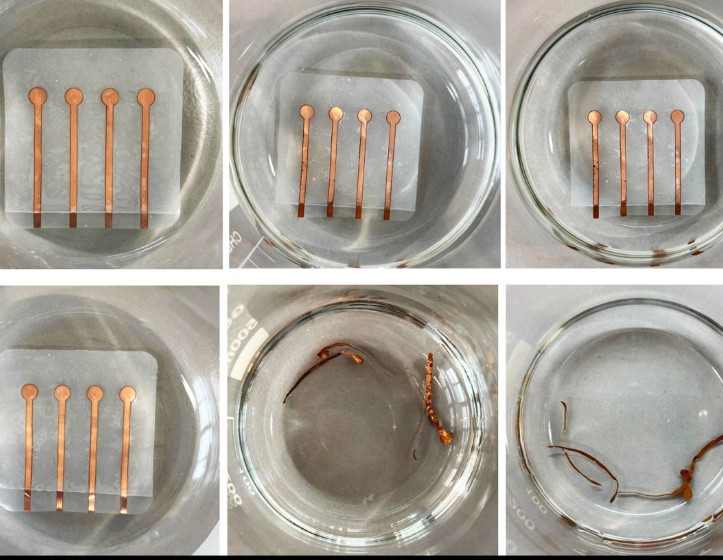
A living plastic with a pair of cooperative, plastic-busting enzymes degraded the material completely within six days. Credit: Adapted from ACS Applied Polymer Materials 2026. Click image to enlarge.
Living plastic enzymes
Teamwork made the new material different because each enzyme – a protein that speeds a chemical reaction – attacked a separate stage of breakdown.
The first enzyme cut long polymer chains, the linked molecules that give plastic its structure, into shorter scraps.
A second enzyme then chewed those scraps into monomers, the basic units that can no longer behave like plastic.
By splitting the work, the microbes avoided the half-finished particles that often make plastic degradation less useful.
Warmth activates dormant microbes
Heat gave the system its switch, raising a food-rich liquid to 122 degrees Fahrenheit so the spores returned to active life.
Once awake, the cells released their enzymes into the surrounding liquid, where the proteins met the plastic surface.
Tests showed that the living film kept strength and flexibility close to plain polycaprolactone before researchers activated it.
After activation, the same plastic film completely broke down within six days, giving the trigger a clear before-and-after effect.
Not built for litter
Cleaner breakdown does not mean the material can be tossed anywhere and expected to vanish on schedule.
In the lab, the researchers controlled heat, food, and moisture, which helped the bacteria do their programmed job.
Compost tests from the earlier one-enzyme platform also showed the plastic broke down faster under warm industrial-style conditions than in cold roadside soil.
That boundary matters because a self-destructing package still needs the right disposal route to keep its promise.
A living plastic with a pair of cooperative, plastic-busting enzymes degraded the material completely within six days. Credit: Adapted from ACS Applied Polymer Materials 2026. Click image to enlarge.
Wearables that disappear later
For a practical test, the team made a flexible electrode from the living material. During testing, it detected muscle electrical signals, a task known as electromyography, while behaving like a normal wearable device.
Under the same activation conditions, the device degraded completely within two weeks instead of lingering as electronic waste.
That small trial points toward temporary medical or fitness sensors, though it does not yet prove mass production.
Bigger plastic challenges remain
Beyond polycaprolactone, the larger idea depends on matching the right microbes, enzymes, and trigger to each plastic type.
Many everyday plastics have chemical bonds that these two enzymes cannot easily cut, including common bottle and food-container materials.
Figures from the Organisation for Economic Co-operation and Development (OECD), an international policy group, show the world produced about 480 million U.S. tons of plastic in 2020, and 397 million U.S. tons became waste.
Scale makes selective design essential, since one clever material cannot carry the whole plastic pollution problem.
Where this helps reduce waste
Packaging waste exposes the mismatch that drove the experiment: many items serve briefly and then persist for years.
“Could we build degradation directly into the material’s life cycle?” asked Dai. That question turned durability into a design target rather than only a cleanup problem after disposal.
For now, the trigger still depends on controlled heat and nutrients, so ordinary litter is not the intended launch point.
Designing safer smart plastics
Engineered materials add a safety question that ordinary plastics do not raise: living cells must stay dormant until needed.
Good designs would require strict containment checks, manufacturing controls, and proof that breakdown products do not create new hazards.
“By embedding these microbes, plastics could effectively ‘come alive’ and self-destruct on command, turning durability from a problem into a programmable feature,” said Dai.
For SIAT’s material, that promise remains strongest in managed settings where the trigger, temperature, and cleanup can all be controlled.
A plastic carrying dormant bacteria, cooperative enzymes, and a clear heat trigger shifts the problem from endless persistence to planned disposal.
Useful products may one day work hard and then exit cleanly – but only if disposal systems are designed around the trigger itself.
The study is published in ACS Applied Polymer Materials.
—–
Like what you read? Subscribe to our newsletter for engaging articles, exclusive content, and the latest updates.
Check us out on EarthSnap, a free app brought to you by Eric Ralls and Earth.com.
—–
Recommended