|
New Study Finally Reveals the Mystery of Antarctica’s Bleeding Glacier
A red stain in Antarctica turns out to be a pressure signal, exposing active water movement beneath one of Earth’s coldest glaciers.


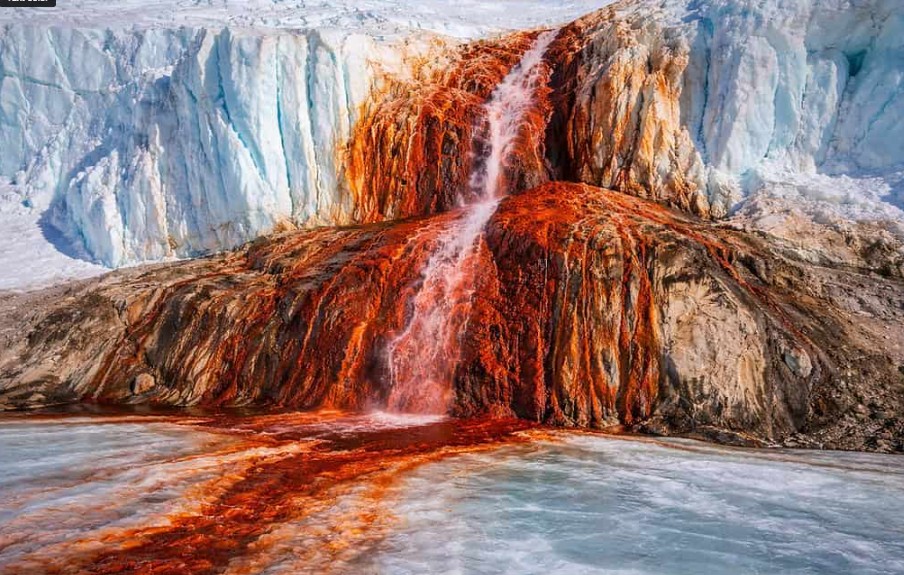
At first glance, it looks like a crime scene—a deep crimson stain spilled across the blinding white ice. Every so often, the streak deepens and fresh red liquid seeps out of Antarctica’s Taylor Glacier. It looks like the ice itself is bleeding.
For over a century, the phenomenon known as Blood Falls has stumped scientists. Not necessarily because it’s red, but because it flows. In an environment this cold, water is supposed to be locked solid. Liquids shouldn’t flow, and pressure shouldn’t build. Yet, something deep beneath the ice has been pushing back.
New research has finally mapped the “plumbing” behind this mystery. It turns out Blood Falls isn’t just a leak, it’s the exit point for a complex, pressurized network of hidden pipes.
The Secret’s in the Salt
Scientists have known for a while that the red color comes from iron-rich water. Deep below the glacier, tiny particles of iron sit suspended in extremely salty water. When that water reaches the surface and comes into contact with air, the iron reacts with oxygen and turns rust-red almost instantly.
However, this answer led to a bigger question: where was this liquid coming from, and how was it still liquid at such extreme temperatures?
The key turned out to be salt. According to the current study, the water beneath the glacier is not ordinary—it’s a dense brine, likely trapped millions of years ago when ancient seawater got sealed under advancing ice.
Salt lowers the freezing point, allowing the water to remain liquid even in deep cold. There’s also a subtler effect: when water freezes, it releases heat. This heat can slightly warm nearby ice, helping pockets of liquid survive longer than expected.
Still, none of this explained the sudden bursts of the red liquid.

To understand what might be happening beneath the ice, researchers first turned to a special radar technique called radio-echo sounding. By sending signals into the glacier and studying what bounced back, they were able to detect hidden pathways inside the ice.
These signals revealed that channels of extremely salty water stretching for hundreds of feet, linking deep reservoirs beneath the glacier to the surface. This was unexpected and it helped scientists piece together a working idea. They started to suspect that brine wasn’t trapped in one place, but moving through a connected network under pressure.
As the glacier slowly creeps forward, its enormous weight presses down on this trapped brine. Over time, the pressure builds, much like squeezing a sealed container. Eventually, the stress becomes too much. Small cracks or pathways open, and the pressurized liquid is forced upward in sudden bursts.
It’s a good theory, but it remained unproven—until a rare moment in 2018 allowed scientists to watch the process unfold in real time.
During a rare outflow event, sensors on the glacier recorded a fascinating chain reaction. As the “blood” began to flow, the surface of the glacier actually dropped by about 0.6 inches (1.5 cm). Simultaneously, the glacier’s forward motion slowed by nearly 10 percent.
This combination provided direct evidence of what was happening below. As the trapped brine escaped, the pressure beneath the glacier suddenly dropped. That caused the surface to sink slightly, while the glacier slowed because there was less water acting as a lubricant at its base.
In other words, Blood Falls is not just a leak—it is a release valve for a stressed system hidden under ice.
These findings are also supported by GPS elevation data, which shows the glacier surface rising faster before such events than after, suggesting that pressure builds up beneath the ice until it is released in short-lived outflows.
More than a strange red flow

This changes how scientists think about cold glaciers. For a long time, places like this were considered almost inactive, too cold to support flowing water or dynamic systems.
However, Blood Falls shows that even in extreme conditions, glaciers can hide moving fluids, shifting pressures, and interconnected pathways.
Moreover, the brine beneath the glacier also hosts microbes that survive without oxygen, relying on chemical reactions involving iron and sulfur. This makes the environment a useful comparison for places like Mars or icy moons, where similar hidden water systems might exist.
There are still some unknown aspects. For instance, the current study takes into account the rare 2018 observations that captured only a short-lived event, and scientists don’t yet know how often these pressure releases happen or how sensitive they are to climate change.
Future work will focus on placing more sensors across the glacier to track these hidden movements over longer periods.
The study is published in the journal Antarctic Science.