Scientists have used the James Webb Space Telescope to discover a galaxy that existed 13 billion years ago, according to a study in Nature. The galaxy, LAP1-B, is one of the most chemically primitive galaxies observed, containing almost no heavy elements. The discovery was made possible through gravitational lensing, which amplified the galaxy’s light by 100 times.
|
Webb discovers one of the universe’s first galaxies
Scientists have discovered a galaxy as it was 13 billion years ago, 800 million years after the Big Bang. It contains possible evidence of the universe’s first stars and is one of the most chemically primitive galaxies observed to date.
The first stars and galaxies are difficult to see because they are so far away and their light is extremely faint. But thanks to the James Webb Space Telescope, we don’t have to remain in the dark about them. This $10 billion observatory was launched in 2021 and can peer back in time to when the first galaxies and stars were forming.
In a paper published in the journal Nature, a team of scientists led by Kimihiko Nakajima, an astronomer at Kanazawa University, Japan, describes how they used the telescope to study a part of the deep universe and discovered a faint galaxy called LAP1-B. “LAP1-B establishes a ‘fossil in the making,’ a direct high-redshift progenitor of the ancient ultra-faint dwarf galaxies observed in the local universe,” they wrote.
A magnifying glass in space
Because the galaxy is so small and distant, it would normally be impossible to see. However, it was spotted due to a phenomenon known as gravitational lensing, in which a massive cluster of closer galaxies acts like a giant magnifying glass, boosting the light from LAP1-B by 100 times.
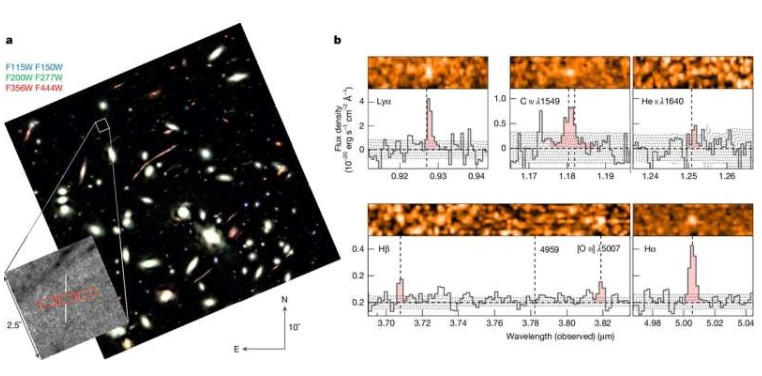
The scientists realized that most of the light from the galaxy wasn’t coming from the stars, but from glowing clouds of gas. They analyzed this light by splitting it into a spectrum and studying the emission lines, which revealed the chemical composition of the gas.
They found that the galaxy contains almost no heavy elements, and its oxygen abundance is about 240 times lower than the sun’s, making it one of the most primitive star-forming galaxies ever observed.
The emission lines also revealed intense ionizing radiation, which is what scientists expect to see from the first generation of stars.
The team also measured an elevated carbon-to-oxygen ratio. This matches the predicted chemical signature for the first star explosions in history from Population III stars, the first stars to exist in the universe. The stars we see today are Population I stars, which formed later and contain more heavy elements.
Another fascinating finding is that, after measuring the gas’s motion and speed, the researchers concluded that the galaxy is held together by a massive cloud of invisible dark matter.
The first stars
Taking all the results together, the scientists believe they have witnessed a rare snapshot of an early stage of galaxy formation, when the first stars began to transform the universe. “Our findings offer a rare window into the earliest stages of galaxy formation.”
Written for you by our author Paul Arnold, edited by Lisa Lock, and fact-checked and reviewed by Robert Egan—this article is the result of careful human work. We rely on readers like you to keep independent science journalism alive. If this reporting matters to you, please consider a donation (especially monthly). You’ll get an ad-free account as a thank-you.