
|
Thirsty desert lizards inspire a new water-harvesting system
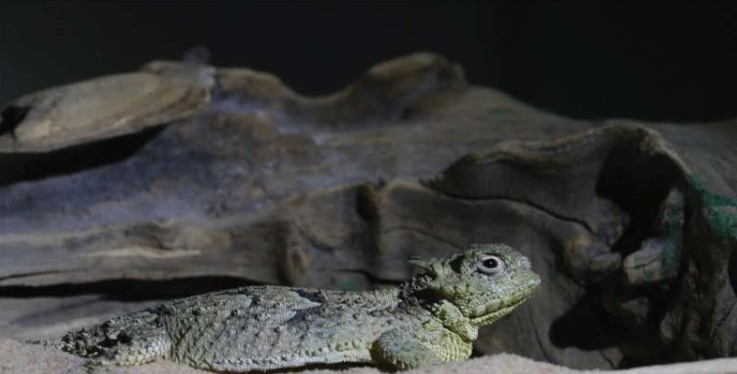
When the desert horned lizard (Phrynosoma platyrhinos) is thirsty, it cannot just lap up water or scoop it up like a bird because it lives in environments where water is extremely scarce. Typically, it’s found in damp soil or, even more rarely, in drops of rain.
Instead, its skin contains microscopic channels between overlapping scales that pull in moisture by capillary action. But how it gets that water from these channels into its mouth has remained a mystery until now.
Scientists have discovered how that happens, and it inspired them to design a water-harvesting system that borrows from how the reptiles do it.
Details of the research are in a paper published in the journal Proceedings of the National Academy of Sciences.
Extracting water from desert sands
The team recorded 12 lizards with high-speed video while dripping water onto their backs. This triggered the skin to suck it up via the microchannels. When researchers reviewed the footage, they saw that the lizards opened their jaws slowly with an uneven movement and closed them quickly. As the jaw opens at this crawl, a continuous film of water pulled from the skin channels breaks apart and moves into the corners of the lizard’s mouth.
“Our research reveals that these lizards employ unique asymmetric jaw movements—characterized by slow opening and rapid closing—to facilitate efficient capillary pumping,” the scientists wrote in their paper.
To calculate how much water is wasted during the jaw movement, they built a replica using two glass plates attached to a hinge and tracked how the liquid coated the surfaces. They discovered that when the device opened at speeds similar to those observed in the lizards, only about 15% of the water was left behind as a coating. That meant roughly 85% was available for collection.
Nature-inspired water harvesting
The study authors then built a water-harvesting system based on the same principle. It uses a sponge to draw water from wet soil and a motorized mechanism that mimics the lizard’s jaw movement to collect it. The sponge was coated with a material called Nafion that removes metal ions, helping to clean collected water.
In tests on simulated damp ground (glass beads soaked in a contaminated water solution), the prototype extracted usable water while removing about 95% of the lead, arsenic and other contaminants.
“By employing a 2D hydrodynamic model, we demonstrated that the lizards’ characteristic slow jaw opening minimizes residual fluid loss, thereby maximizing water intake efficiency,” said the researchers.
The research team now hopes to scale up their nature-inspired system to build automated, large-scale harvesters that could one day provide clean drinking water to drought-prone communities.
Written for you by our author Paul Arnold, edited by Gaby Clark, and fact-checked and reviewed by Robert Egan—this article is the result of careful human work. We rely on readers like you to keep independent science journalism alive. If this reporting matters to you, please consider a donation (especially monthly). You’ll get an ad-free account as a thank-you.