Scientists find sugar near the center of the Milky Way
Intriguing to find a complex chemical found in food on Earth present in distant space. Did biologically important chemicals all evolve here or did some (or most or all) come from outer space?
Astronomers have found erythrulose, a type of sugar, in a gas cloud near the center of the Milky Way, according to a study in Nature Astronomy. This marks the first time erythrulose, a sugar found in raspberries, has been discovered outside the solar system and adds to research identifying life-friendly compounds, such as water, in the galaxy. “The findings suggest that erythrulose can be made from simpler molecules on dust grains in space, and may then become part of more complex chemical systems,” researchers wrote.
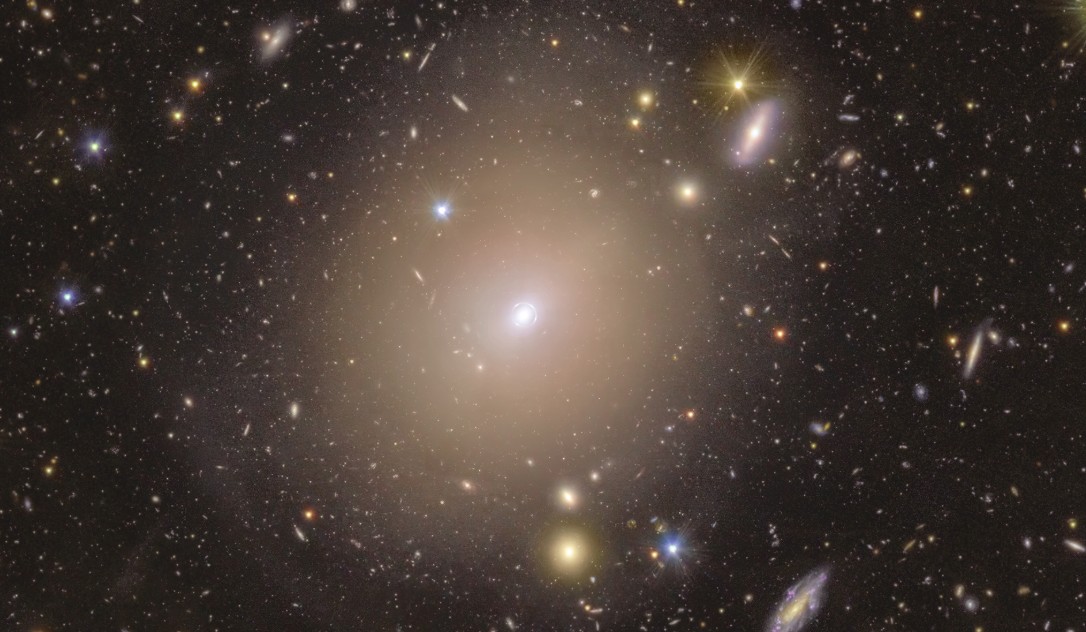
A Hubble image of the Milky Way’s center, in the constellation Sagittarius. Researchers have discovered a sugar found in raspberries buried in a cloud in this region.
(Image credit: NASA, ESA, and G. Brammer)
Interstellar space just got a little sweeter: A type of sugar called erythrulose has been found near the center of the Milky Way, according to a new study.
The detection, made in a gas cloud called G+0.693-0.027, is the first time this sugar has been found outside the solar system and adds to research identifying similar life-friendly ingredients around our galaxy, such as water.
Erythrulose, which is made up of four carbon atoms, is also found in raspberries. Its interstellar presence was confirmed by the Yebes 40-meter and IRAM 30-meter radio telescopes in Spain, the research team reported Monday (July 13) in the journal Nature Astronomy. The signal of erythrulose was confirmed with patterns measured in the laboratory.
While space researchers often focus on water and carbon when searching for the ingredients of life, sugars are also essential. “Sugars are important molecules in living systems, helping to provide energy, build important biological structures, and form parts of genetic material,” the researchers said in a statement.
“We were able to achieve this detection thanks to the combination of exceptionally sensitive observations, extensive frequency coverage, and highly accurate laboratory spectroscopic data,” study co-author Izaskun Jiménez-Serra, a staff researcher at the Spanish National Research Council, told Live Science in an email. “In addition, our astronomical target is one of the richest chemical inventories in the galaxy, which enhances the probabilities of detection,”
Finding erythrulose, he added, “is particularly relevant for the field of origins of life” because that sugar changes the configuration of threose — yet another sugar which is believed to be the precursor of the first nucleic acids that evolved into RNA and DNA.
The Milky Way rises during a clear summer night over a radio telescope from the Yebes Observatory.
Previously, scientists could not figure out how erythrulose could be made in conditions simulating the early Earth. That’s because lab experiments “yield insufficient concentrations” of erythrulose on the surface of prebiotic (pre-life) Earth, the researchers explained.
The new finding of erythrulose in an interstellar gas and dust cloud, by contrast, suggests that erythrulose could be found in the interstellar medium for incorporation into rocky planets like Earth earlier, when they are first forming and evolving.
As such, ribose, glucose and erythrulose could have been part of the “sugar inventory” on Earth before it fully formed, the researchers said. “The findings suggest that erythrulose can be made from simpler molecules on dust grains in space, and may then become part of more complex chemical systems,” the team said in the statement.
The sweet detection adds further evidence to the theory that many, if not all, of the essential ingredients of life are plentiful in space.
“One of the most exciting next steps is to search for even more complex sugars and for molecules that are direct precursors of RNA, and other biologically important compounds,” Jiménez-Serra told Live Science. “We want to understand how far prebiotic chemistry can progress before planets are even formed, and what chemical inventory young planetary systems inherit from interstellar space.”
TOPICS
Live Science Contributor
Elizabeth Howell was staff reporter at Space.com between 2022 and 2024 and a regular contributor to Live Science and Space.com between 2012 and 2022. Elizabeth’s reporting includes multiple exclusives with the White House, speaking several times with the International Space Station, witnessing five human spaceflight launches on two continents, flying parabolic, working inside a spacesuit, and participating in a simulated Mars mission. Her latest book, “Why Am I Taller?” (ECW Press, 2022) is co-written with astronaut Dave Williams.
By mazzuki1|2026-07-14T23:38:25-04:00July 14th, 2026|Kool-Sci DAILY|Comments Off on Scientists find sugar near the center of the Milky Way